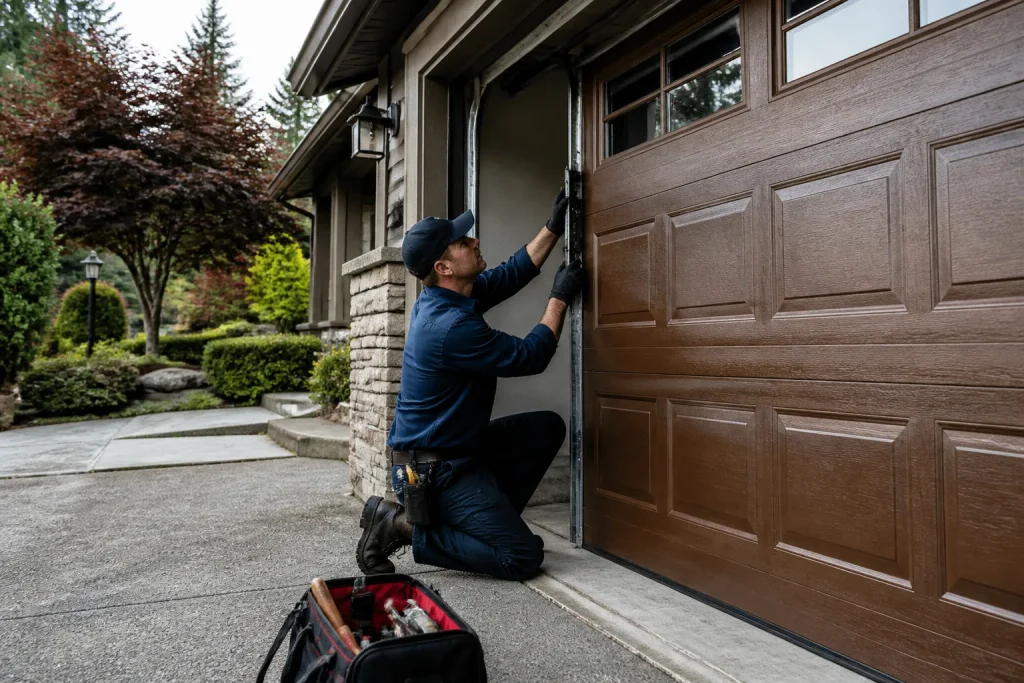
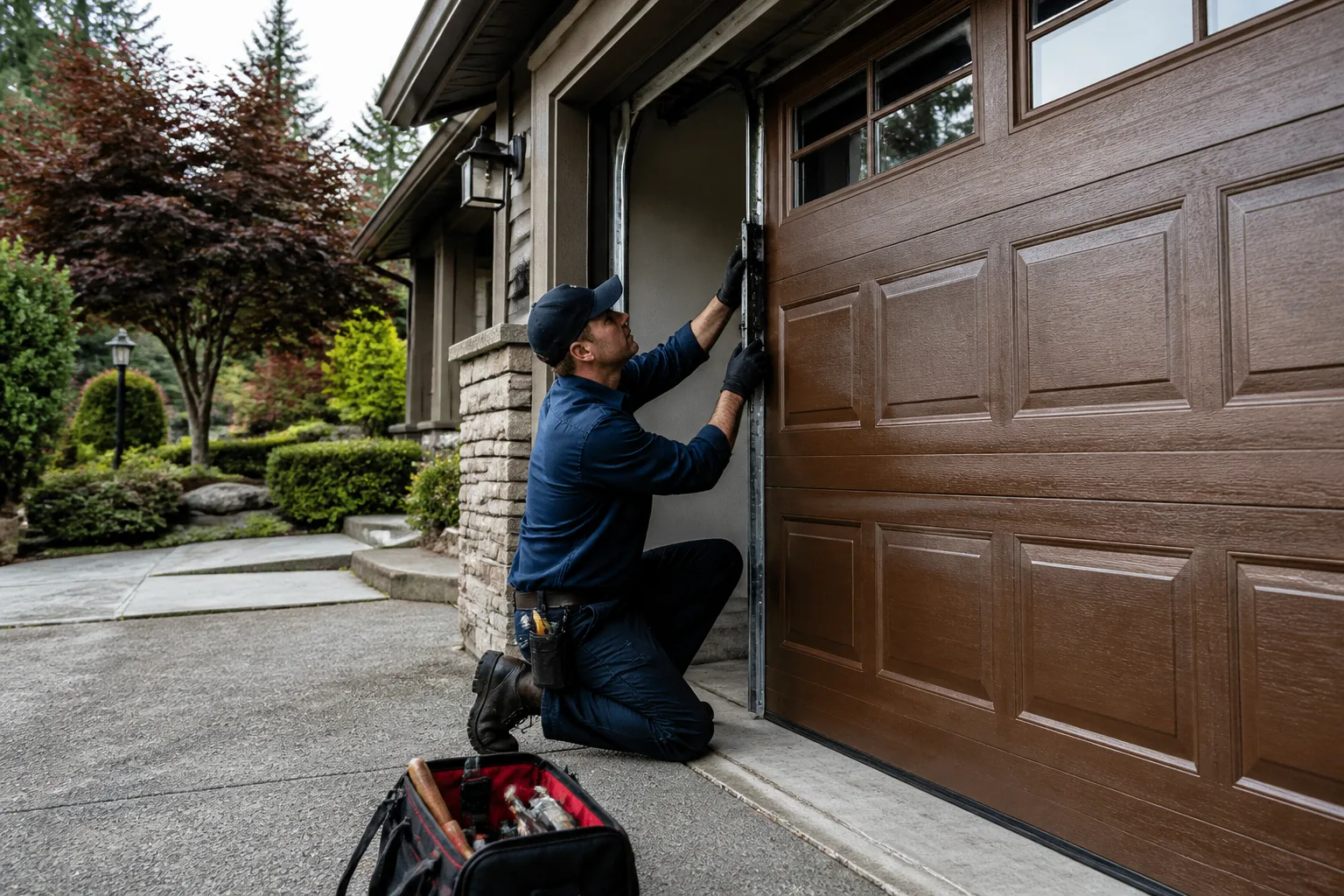
Craftsman Garage Door Repair in Issaquah: A Homeowner’s Guide
Craftsman stopped selling garage doors through Sears in 2018, so the “Craftsman” badge on your door almost certainly started life as a rebadged unit built by one of a few manufacturers. That matters more than you’d think: most repair companies quote parts for the wrong OEM and then tell you the part is unavailable. In Issaquah, where temperature swings work older doors hard, knowing the difference is the whole game. If you’d rather not DIY, call (833) 754-9516.
What does a Craftsman label actually tell you about your door?
A Craftsman label tells you the door was sold under the Sears house brand, not necessarily who built it. Sears sourced garage doors from multiple manufacturers over the years, and the badge stayed the same while the actual hardware underneath changed. The three lineages you’re most likely to run into on an Issaquah door are Chamberlain, Raynor, and Wayne Dalton. Each one has its own spring setup, its own track and roller profile, and its own panel construction, which is why a “Craftsman replacement part” is often a wild goose chase until someone identifies the original maker.
We’ve seen Issaquah homeowners handed a quote for hardware that was never going to fit, simply because the tech assumed the label was the manufacturer. It isn’t. Once you know the lineage, the right parts are usually straightforward to source, and the repair goes back to being a repair instead of an ordeal.
How do you identify the OEM manufacturer behind your Craftsman door?
Check the model label on the door itself before anyone quotes you anything. Here’s how we walk Issaquah customers through it:
- Find the label. It’s usually on the interior face of the bottom panel, on the end stile, or behind the hinge on the left or right edge.
- Write down the full model number. Not just the first chunk. The prefix and the ending digits both carry information about the build line.
- Read the prefix. A number beginning with a Chamberlain-style sequence usually cross-references to Chamberlain or LiftMaster hardware. A Raynor or Wayne Dalton sequence will look different and handles its springs and panels differently.
- Check the weather seal and hinges for manufacturer marks. Small stampings often confirm which lineage built the door.
If the label is worn off or painted over, a technician can identify the door by the spring anchor plate, the track bracket shape, and the panel rib pattern. That’s the moment to call a pro rather than guess. When you want it handled in one visit, our garage door repair team carries the identification tools and the cross-reference tables to match it up.
Why Craftsman opener parts cross-reference to Chamberlain 139.x numbers
Craftsman openers were built by Chamberlain, so the electronics inside are Chamberlain parts wearing a different case. The remote controls, the logic board, the gear and sprocket assembly, and the safety sensors all trace back to the Chamberlain 139.x series specification. In plain terms: when a repair company tells you a Craftsman opener is obsolete and can’t be fixed, what they usually mean is they don’t have the cross-reference. We do.
That cross-reference changes the whole repair conversation:
- Remotes reprogram, they don’t need replacing. Lost remote or a remote that stopped matching? Reprogramming takes minutes.
- Logic boards are sourced, not improvised. A board that matches the 139.x series drops in and works the opener the way it did on day one.
- Safety sensor alignment is a repair, not a swap. The sensors are the most misdiagnosed part on the whole unit. Nine times out of ten they’re misaligned or the wiring has a nick, and the opener gets blamed.
- Gear and sprocket wear is repairable. A noisy, grinding opener usually needs the wear parts, not a whole new unit.
If you’re weighing a repair against an upgrade, our garage door opener repair service covers the full Craftman-to-Chamberlain cross-reference and the modern LiftMaster and Genie platforms that replace aging units. Issaquah homes with older openers benefit from the smart-hub compatibility of LiftMaster myQ and Chamberlain units, but we won’t push a new opener when a $40 part fixes yours.
Spring calibration: the Craftsman difference that catches people out
Older Sears-era Craftsman doors were often built with spring setups calibrated to the door’s specific panel weight and height, and the replacement hardware on the market today is not always a straight swap. Wire gauge, inside diameter, and the length of the spring all need to match the door’s actual load, and “close enough” is how doors end up hard to lift or, worse, slam shut.
This is the part of the job where we slow down. Garage door springs are under heavy tension and can cause serious injury if they let go while someone is working on them. We don’t give step-by-step instructions for spring work, and neither should any guide you read online. What you should know is that a mismatched spring isn’t a small problem: it strains the opener, warps the panels, and won’t hold the door in a halfway position the way it should. On a matched pair, the springs are usually replaced together, so the pair costs roughly twice a single spring. Our garage door spring repair team handles the calibration on Craftsman and Wayne Dalton doors routinely and can tell you within a few minutes of looking whether the hardware on the door is original or already been swapped.
Which Craftsman repairs are safe to handle yourself?
Some Craftsman fixes are genuinely fine to do yourself. Others carry real injury risk, and we’d rather you call than test your luck. Here’s how we draw the line for Issaquah homeowners:
Reasonable DIY
- Remote reprogramming. Follow the opener manual’s pairing sequence. No tools, no risk.
- Limit switch adjustment. If the door reverses a few inches off the floor or doesn’t close flush, the travel limits need a small adjustment. This is a screwdriver job.
- Safety sensor cleaning and alignment. A dirty lens or a bumped bracket is common and easy to fix.
- Lubrication. Garage door lubricant on the hinges, rollers, and track cuts noise and wear.
- Weather seal replacement. The bottom seal is a straightforward swap on most panels.
Call a professional
- Spring replacement. The springs hold the door’s full weight under tension. This is the single most dangerous repair on the door.
- Cable rewinding. Cables are under the same tension and can whip when released. Not a DIY job.
- Panel or section replacement. A bent or cracked panel changes the door’s balance, and the springs need recalibrating to match.
- Track realignment. A door that’s jumped the track can fall. Leave it to someone with the right bracing.
- Opener logic board or gear replacement. Low injury risk, high chance of getting the wiring wrong without the service manual.
When in doubt, look at the door, ask yourself whether a mistake could drop several hundred pounds of panel on you, and if the answer is yes, put the tools down. That’s our general rule.
When Issaquah weather works on a Craftsman door
Issaquah sits in a climate with real seasonal temperature swings, and older Craftsman aluminum panel doors feel every one of them. Aluminum expands and contracts more than steel, and on a door that’s twenty-odd panels old, that expansion shows up in specific ways you can watch for.
In summer, the panels expand against the frame and the door can start to bind in the tracks. Listen for a scrape or a pop on the way up. The bottom seal also hardens in the heat and can start to pull away.
In fall, the tracks collect debris and the rollers start to squeal. That’s the season to clean and lubricate before the cold settles in.
In winter, metal contracts and old weather seals crack. A seal that’s split lets cold air and moisture in, and moisture around the bottom panel is where you’ll first see corrosion on an aluminum Craftsman door.
In spring, the freeze-thaw cycle loosens hinge screws and can shift the track slightly. A door that ran quiet all winter can suddenly start grinding in April.
None of these are emergencies on their own, but they compound. A door that binds in summer puts strain on the springs through the fall, and by winter the springs are working harder than they should. If you notice a pattern, that’s the moment to have the whole assembly looked at.
The Bottom Line
Your Craftsman door is probably a Chamberlain, Raynor, or Wayne Dalton underneath, and the right repair starts with identifying which one. The opener cross-references to Chamberlain 139.x parts, which means “obsolete” is usually a sourcing problem, not a real dead end. Springs need a trained hand, remotes and limit switches don’t, and Issaquah’s seasonal swings keep older aluminum panels working. If you’re in Issaquah and need help, Issaquah Garage Door Repair Pros offers free estimates – call (833) 754-9516. Our technicians have up to 12 years of experience, and we work on your brand across LiftMaster, Chamberlain, Genie, Clopay, Amarr, Wayne Dalton, Craftsman, and Raynor. One call covers it, from a sticking remote to a full replacement. You can also start at Issaquah Garage Door Repair Pros if you’re not sure which service you need, and every price is quoted and agreed before any work starts.
Frequently Asked Questions
Usually yes, where openers are concerned. Craftsman openers were built by Chamberlain, so the electronics inside match the Chamberlain 139.x series and parts cross-reference directly. Craftsman doors, on the other hand, could have come from Chamberlain, Raynor, or Wayne Dalton, so you need the model label to know which. Call (833) 754-9516 and we can identify it for you.
Yes, in most cases. The trick is matching the part to the OEM manufacturer behind the badge, not to the Craftsman name itself. Once the door is identified, springs, hinges, rollers, and seals are usually sourced without much trouble. If a company has told you the parts are unavailable, get a second opinion before you buy a new door.
The travel limit switch is out of adjustment about half the time. The other common cause is a misaligned or dirty safety sensor, or nicked sensor wiring. Both are simple fixes. If the limit adjustment doesn’t hold or the door still reverses, the logic board may be the culprit, and that’s a job worth handing to a pro at (833) 754-9516.
Repair it if the panels are structurally sound and the hardware is serviceable. Replace it if panels are cracked, the door has been re-sprung to compensate for weight it should never have carried, or the opener is on its last legs. A free estimate will tell you which side of the line you’re on, and the written quote sets the final price before any work begins.
Written by the team at Issaquah Garage Door Repair Pros.
Need Garage Door Help?
Call Issaquah Garage Door Repair Pros - the local pro we connect you with is licensed and insured, here with fast after-hours help in Issaquah.
(833) 754-9516